By: MICHELE PENDRAK BUSH, O.D.
When it comes to eyes, what products you put on or around them can have a significant impact on your dry eye signs and symptoms (opens in new tab). More recent studies (opens in new tab) of common cosmetic ingredients also raise concerns regarding overall “cytotoxicity, genotoxicity, mutagenicity, neurotoxicity, and estrogenicity.” In this blog post, I’ll give you the “how,” and the “why,” as well as some specific recommendations for clean makeup. Prepare to be surprised! You may find that that the “hypoallergenic” and “safe” makeup you’ve been using for years is anything but.
Let’s start by reviewing the 1938 Food, Drug, and Cosmetic Act. It is hard to believe, but this is the last time legislation was passed regarding what ingredients are put in the cosmetic products we put on our bodies every single day. Under that act, “cosmetics and their ingredients, with the exception of color additives that are not coal-tar hair dyes, are not required to undergo approval by the FDA before they are marketed in products sold to the public.” In short this means that the ingredients that go into our makeup products do not need to be regulated. Some ingredients have been banned, but let’s do a comparison. The United States has 30 banned products in comparison to Europe who has banned 1328 chemicals from cosmetics. The U.S. actually trails 40 nations when it comes to cosmetics safety and regulation of chemicals in personal care products. This is why it makes sense for people to understand ingredients and become familiar with the resources available to help make purchasing decisions regarding makeup and personal care products.
Most of us have heard of some of the worst offenders that are commonly in our makeup and personal care products – formaldehyde (that would be the same chemical used to embalm bodies and those frogs we dissected in biology class), parabens (opens in new tab), and phthalates to name a few.

I must admit that a turning point for me was when I was pregnant and then taking care of my babies – everything had prominent phrases such as “paraben free” on the labels. We are taught to be so careful when we are pregnant, nursing, and caring for infants. Then when I was no longer pregnant and the children grew older I thought, “Wait a second… so now it is okay to go back to using all of these known carcinogens and toxic chemicals?”
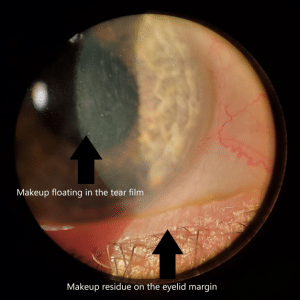
At the same time, I was also digging my heels into my dry eye specialty and awareness was increasing about just how bad some of those common makeup and personal care product ingredients are for us. I often noticed that the women with the worst atrophy and scarring of their meibomian glands (the delicate oil glands that line our eyelid margins) also had this very particular “sheen” of makeup on their eyelid margins – and no I’m not just talking eyeliner and mascara, I am talking foundations and powders as well. When I would gently try to talk to these women about proper eye makeup removal, they would often reply that they did not apply makeup to their eye area, that they always washed it off at night, or that they had not even applied eye makeup that day. However, I could still see the sheen (captured in the photo to the left).
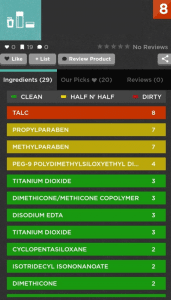
One particular day we had 3 women in a row getting a procedure done called meibomian gland puncture in which we have to puncture scar tissue that has formed on the oil glands in the eyelids in order to create an opening for the gland again. All of them had the eyelid “sheen.” So I started asking them what products they were using and looked them up the Think Dirty App (opens in new tab) and the Environmental Working Group’s Healthy Living App (opens in new tab). These are apps in which you can look up your particular personal care product, and they will give it an overall rating from 0-10 with 0 being a “clean” or perfect score. They will then break down each individual ingredient with a brief explanation as to why each ingredient received that rating, as well as any relevant studies and research related to it.
Here is a screenshot of a powder one of these women was using:
Look at those ingredients! Titanium dioxide alone could partially explain the “sheen” we were seeing, and that doesn’t even receive a poor rating! Parabens (the ingredients in yellow) are an ingredient that should always be avoided. Parabens initially got a (much deserved) bad rap in a 2004 study (opens in new tab) that isolated parabens completely intact from samples of human breast tumors. We have since learned that they are hormone mimickers. Meibomian gland secretions are partially controlled by hormones, so this is why there is a strong association between use of products with parabans and dry eye. This is confirmed by The International Workshop on Meibomian Gland Dysfunction in 2011 (opens in new tab) where the association between parabens and a decreased release of oil from the meibomian glands was reported.
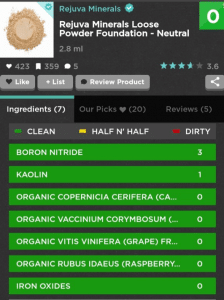
By contrast, here is a screenshot of a face powder from Rejuva Minerals (opens in new tab), one of a few makeup companies I have been recommending to my patients who had previously given up on wearing makeup due to dry eye symptoms:
So what ingredients should you be looking to avoid and why?
If this gets overwhelming and you just want to know what to use, skip to the end. For those who want to know more, This study (opens in new tab) gives an excellent summary of what I have highlighted below and also reviews the (scary) prevalence of these ingredients in our health and beauty aids. A consumer tipis to always read the ingredient list on the back. The label on the front touting “Free of…” never tells the whole story. There can still be plenty of the bad stuff in these products. You just need to read the label to find them.
Below is a list of some of the top ingredients that are known ocular and skin irritants (opens in new tab), skin sensitizers (opens in new tab), hormone disruptors, and carcinogens:
- BAK or BAC – Benzalkonium chloride is a preservative that is in pretty much everything, but for our purposes it is in a lot of preserved eye drops and cosmetics. For years we have seen how irritating BAK is to the ocular surface. Thanks to more recent studies (opens in new tab) we are starting to understand how damaging they are to the meibomian glands, cornea, and conjunctiva on a cellular level, resulting in cell death with as little as 10 minutes of exposure (opens in new tab) at higher concentrations.
- Formaldehyde and formaldehyde releasers – this labeling can be tricky and easy to miss because examples of formaldehyde releasers are DMDM – Hydantoin, Quaternium-15, etc. Studies have demonstrated (opens in new tab) that BAK and formaldehyde releasers “induced cell atrophy, poor adherence, decreased proliferation and death, after 5 days of exposure” to meibomian gland, corneal, and conjunctival epithelial cells. Cellular signaling was reduced after only 15 to 30 minutes of treatment. That’s it! 15 minutes!
- BHA and BHT – there’s enough science out there telling us these chemicals in various quantities are carcinogenic (opens in new tab) and cytotoxic (opens in new tab) that makes it wise to avoid them!
- Isopropyl Cloprostenate (in lash growth serums) or any prostaglandin (e.g. latanoprost)/prostaglandin analogue (opens in new tab). Much more can be read about this topic in the post about eyelash growth serums.
- Retin A/retinoids (including Triretinoin) – Sometimes these are used as a form of skin cancer prevention, and obviously a life threatening condition such as skin cancer takes precedence. These are also used as a form of acne treatment (opens in new tab) which can have a huge effect on an adolescents’ sense of self esteem. But retinoids truly wreak havoc on the meibomian glands (opens in new tab), often leading to significant atrophy (opens in new tab), so it is an important consideration. Studies (opens in new tab) have found that even topical retin a (a potent anti-aging agent) “alters meibomian gland epithelial cell gene expression, reduces the activity of cell survival mediators, inhibits proliferation, and induces meibocyte cell death. ”
- Parabens – These are known endocrine disruptors (opens in new tab), carcinogen, and decreases meibomian gland secretions (discussed in detail above).
- Phthalates – another known male (opens in new tab) and female (opens in new tab) endocrine disruptor, more recent studies point towards it being carcinogenic (opens in new tab) as well.
- “Fragrance” – This is considered a proprietary term, so companies often use this as a “catch all” to hide toxic ingredients which they would rather not put on the label.
- Sodium Lauryl/Laureth Sulfates (opens in new tab) (and most sulfates) – These are foaming agents, so they are in pretty much anything that foams. Sulfates are a known common skin irritant. It is not uncommon for people to have an SLS allergy.
- Phenoxyethanol (opens in new tab) – One of the most commonly used makeup preservatives. Studies (opens in new tab) have shown that at concentrations as low as 1% it can cause burning, itching, and hives in sensitive individuals, and can even induce hives and eczema. At higher undiluted doses with long-term exposure, its Material Safety Data Sheet (MSDS) states that it can cause skin and lung irritation and is toxic to the kidneys, nervous system, and liver.
- Ureas (imidazolidnyl, diazolidinyl, etc.) – often used in waterproof makeup, is another formaldehyde releaser.
- Bromo-2-Nitropropane-1 3 Diol (bronopol (opens in new tab)) – often in wet wipes and known for causing contact allergies
- Talc – among other things, it has been linked with certain cancers (opens in new tab)
- Glycols
- Propylene glycol (opens in new tab) – This is used as a solvent. It was named the American Contact Dermatitis Society’s Allergen of the Year for 2018 (yes that’s a thing).
- Butylene glycol – This is used as a humectant to prevent moisture loss. Cases of contact dermatitis (opens in new tab) have been reported.
- Polyethylene glycol (“PEGS” (opens in new tab)) – click here (opens in new tab) for an excellent summary about PEGs.
- Metallic ingredients (titanium dioxide), metallic colors, and glitter (which can easily get in your eyes) are all eye irritants
- Ethylhexyl Dimethyl PABA (opens in new tab) – These are commonly used in sunscreens to absorbs UVB light. The ultimate irony here is that many studies have “confirmed increased mutagenicity following exposure to sunlight,” which suggests that it may actually contribute to sun-induced cancer. Previous studies have also demonstrated that it is toxic to the testis, epididymis, spleen, and liver. At the very least, it’s a skin irritant and sensitizer (opens in new tab).
- Oxybenzone, Oxtinoxate (opens in new tab) – These are commonly in sunscreens. Recently they have been identified as endocrine disruptors and reported to produce contact and photocontact allergies. They are being banned in Hawaii (opens in new tab) due to coral bleaching and the effect they have on the environment. Sidenote about sunscreens: Mineral sunscreens are preferred, specifically non-nano zinc oxide lotion (try to avoid spray on forms since it is best not to inhale it).
- Tea Tree Oil (TTO) – For years, this was our go-to for treating a type of eyelid inflammation called blepharitis caused by a mite called demodex. A 2005 study (opens in new tab) proved that this was the only thing that effectively killed demodex – not iodine, not alcohol, not any other ingredient in the study. Then a study came out in 2020 (opens in new tab) that demonstrated that TTO even in low concentrations is toxic to our meibomian glands and it was back to the drawing board. Luckily LLLT and IPL are known for killing demodex (opens in new tab), often on contact (opens in new tab)! (more on that later)
- Argireline – This is a peptide similar to botox and often promoted as “botox in a bottle.” Botox is interesting – when used for crow’s feet (opens in new tab), it has been known to exacerbate dry eye. However when used in other areas like the inner eyelids (opens in new tab) or for migraines (opens in new tab), it is becoming an accepted treatment for dry eye disease. Because many people are using argireline over the entire eye area, it is quickly developing a reputation for exacerbating dry eye signs and symptoms (opens in new tab).
Being familiar with these ingredients is important, but if you are new at this or simply don’t think you can remember all of these (it is a lot!), it is encouraged that you to use the previously mentioned apps to vet personal care products.
I have personally made the switch exclusively to clean products and I do not miss my old, irritating, often times carcinogenic products one bit! When I initially made the switch, I still had some of my old waterproof mascara laying around that I would use on occasion. When I would see my husband at the end of the day on those days, he would look at me with great concern on his face and say “Oh my goodness have you been crying? Your eyes are so red and teary?” No honey – I just used my old “dirty” makeup again.
Let’s look at a comparison of my old “dirty” mascara vs. the “clean” version I now use:
Here’s the old “dirty” one (cringe!):
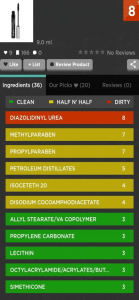
Here’s one of the clean mascaras in my rotation:
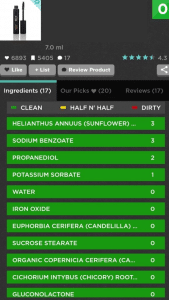
What a difference! When I use the clean version, there’s no more burning, redness, drying, irritation, or other nuisance dry eye symptoms.
We recently started carrying Éyes Are The Story’s mascara trio in the Siepser Dry Eye Center of Excellence. This is a great product – not just because it was created by an optometrist – but also because it is made of completely clean ingredients and it comes as three smaller tubes (pictured below) so that your mascara is never allowed to sit around and get old. Remember – we should be changing all of our eye makeup every 3 months so that it is not allowed to collect and grow microorganisms.
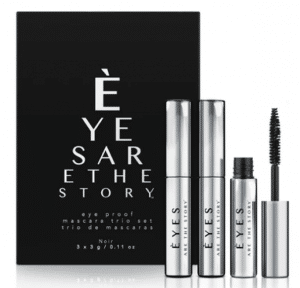
This mascara has been a game changer for so many of my patients who thought they were no longer able to wear mascara because their eyes felt too dry or they were “allergic to everything.”

By the way – it works beautifully.
Here is Tiffany – our Upneeq (opens in new tab) representative – having fun with us in the Dry Eye Center one day trying on and modeling the Éyes Are The Story Mascara in one eye.
Upneeq is a topic for another blog post, but in the meantime you can learn more about Upneeq here (opens in new tab). It is a prescription eyedrop that gives you an eyelid lift for the day. We have samples and boxes for sale in the Dry Eye Center. I am happy to evaluate if you are a good candidate for it during a dry eye evaluation.

Finally, one last note about eyeliner. Never ever, ever, ever, ever tightline (pictured to the left). Your eyeliner. Never. Ever. Tightlining is the technique of lining your upper waterline, the area inside the lash line.
It blocks the oil glands in your eyelids. In the short-term, you are looking at irritation, dry eye symptoms, and eventually maybe even a chalazion (aka a “stye”). In the long term you are looking at permanent damage to those glands – clogging, atrophy, and scar tissue formation. And once those glands are gone, they’re gone. Trust me – you don’t want to end up in my chair one day as a Level 4 dry eye patient (that’s the most severe category) with me telling you I’ll do my best, but our success is going to be limited because your glands have mostly atrophied.
The bottom line is, if you have dry eye and have given up on wearing eye makeup, know that you absolutely can wear it. Your products simply need to have clean, eye friendly ingredients. Even if you feel as though you do not have dry eye, you should still start wearing clean makeup products now so you don’t cause potential long term damage to your eyes. Clean products are readily available and more affordable than you might think.
At the Dry Eye Center, I am always happy to help you clean up your makeup routine as part of your tailored treatment plan. We also offer Low Level Light Therapy and Intense Pulsed Light Therapy which can help many of the areas you are trying to cover with makeup. We utilize these for the treatment of dry eye. However, these therapies are safe and have additional, amazing skin benefits that you are sure to enjoy.
If your eyes are feeling dry and irritated, you don’t have to accept it. Come and see me for a comprehensive dry eye evaluation. I hope to see you soon!